Free research sample · Sources checked 15 September 2026 · Historical case study
Shijian-21: assessing GEO servicing capability
OrbitRabbit assessment: SJ-21 is best assessed as a GEO orbital-servicing technology demonstrator. The reported BeiDou-G2 relocation provides the stronger capability evidence; subsequent SJ-25 proximity reports support a servicing interpretation, while propellant transfer remains unconfirmed in the sources reviewed here.
For an analyst comparing servicing capabilities, relocation belongs in the evidence-based baseline. Refuelling belongs in a conditional scenario until stronger evidence is available. The announced debris-mitigation purpose and servicing capability are compatible.
Download the earlier source chronology (PDF, 10 Sep) Check subscription language coverage
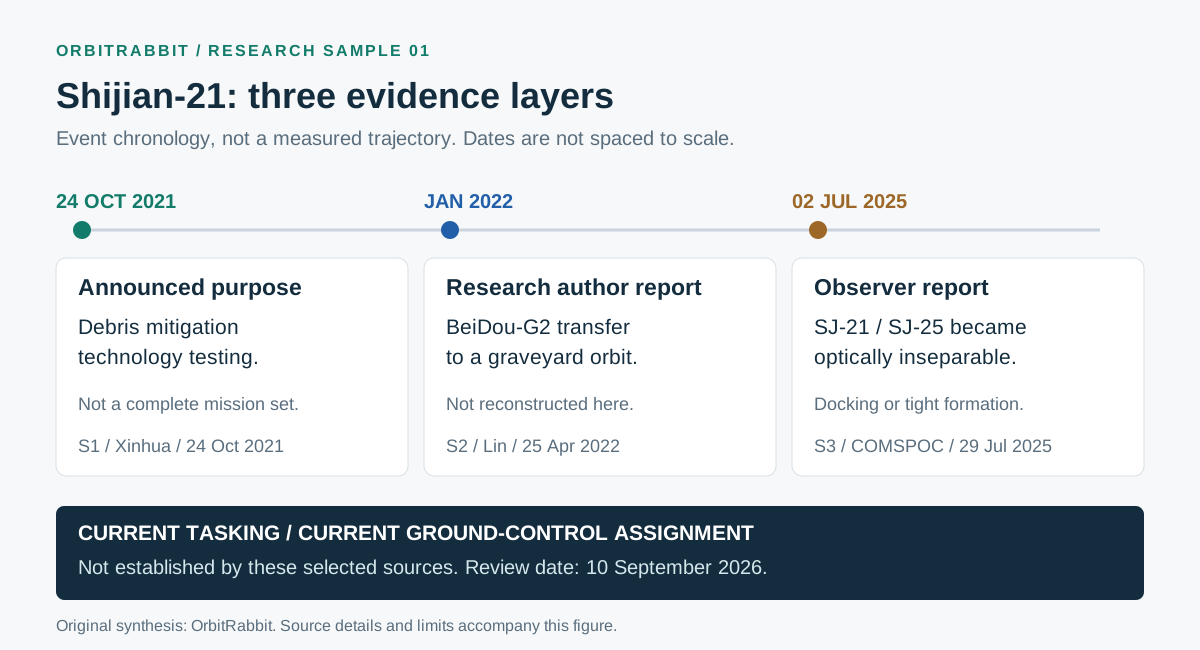
1. Announced purpose · 24 October 2021
Xinhua reported Shijian-21's launch from Xichang and described its principal purpose as testing and validating space-debris mitigation technologies. This establishes the public description given at launch. It does not establish a complete mission portfolio or later operational tasking.
2. Reported operation · January 2022
Lin reports SJ-21's January 2022 relocation of BeiDou-G2. His study analyses 2010–2019 photometry to predict the target's rotation for docking preparation. It combines PMO observations with additional Graz measurements and reports one-year prediction errors below 3° for the rotational axis and 0.11°/s for rotational speed. These are the study's model results, not SJ-21's measured navigation accuracy.
The useful analytical connection is between target-state knowledge and servicing preparation. Optical observation support is relevant to that assessment; it does not identify a controlling ground station. We have not replicated the model or reconstructed the transfer trajectory.
S2 · arXiv:2204.09258v2, 25 April 2022 — especially pp. 1–2 and 5
3. Observer report · 2 July 2025
COMSPOC's published description says Shijian-21 and Shijian-25 became optically inseparable on 2 July. It retains two explanations: docking or very tight formation flying. Our review covers the provider's description, not its underlying observation data. Optical inseparability alone is insufficient here to label docking or refuelling as confirmed.
S3 · COMSPOC, published 29 July 2025 — published description reviewed